Hyde & Rugg:
We solve hard problems
Hyde & Rugg:
We solve hard problems
The way people categorise objects or concepts varies between individuals. Sometimes people aren’t even aware of how they categorise objects or concepts until you get them to think about it.
Sorting is a powerful way of discovering how individual people categorise things, and how much agreement and disagreement there is between individuals.
You can ask people to sort real objects like mobile phones or rock samples, and there are advantages in using the real thing if touch or smell are key features. But cards showing an image or text are much more manageable and are suitable for most purposes.
In a card sort each card shows a picture, or text such as a product name. Each card is given an identifying number.

We ask people to sort the cards repeatedly into groups (categories) of their own choice, using their own criteria. For each different criterion, we record which cards are in which category, using the identifying numbers on each card.
•Cards are cheap and easy to produce, versatile and easy to manage.
•Cards showing images can be sorted by people who speak a different language to the researcher, or by people who can’t read, or can’t speak.
•Using numerals to identify cards means that recording and analysis can be done by someone who has no idea what’s being sorted. So card sorts can be used for sensitive topics, confidentiality can be safeguarded and researcher bias reduced.
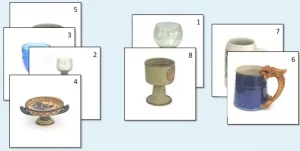
We usually demonstrate card sorts using a pack of cards showing various drinking vessels – because most people will be familiar with them as a class of objects. This tutorial explains how we would carry out card sorting with a participant.
What you need:
•mini card pack to demonstrate the sorting process
•main card pack for the main card sorting.

Sort the mini pack cards into groups.
•Demonstrate the names you’ve used for the groups and your overall criterion for sorting. So your groups might be “for wine”, “for beer or wine”, and “for beer”, using the criterion “the drink they’re intended for”.
•Explain that you would then re-sort them using a different criterion, such as “the material that they’re made of” .
•Mention that you could use “don’t know” and “not applicable” groups.
•Make it clear that there are no right or wrong answers.

Tip: Don’t let them see the main pack until you’ve finished your demonstration, or they’ll start sorting before you’ve finished explaining.
The picture below shows eight cards sorted into three categories.