
Hyde & Rugg:
We solve hard problems
Hyde & Rugg:
We solve hard problems

Tips:
•If they have trouble thinking of categories, choose two cards at random and ask what the main single difference is between them. This can then be used as the basis for a further sort.
•Don’t comment on their categories, no matter how strange these are; usually, the categories make sense later.
•If you think they’re trying to use two criteria for sorting at the same time (e.g using a group called “big and expensive”) then check tactfully and clarify that they can sort on each criterion in a separate sort (e.g. one for “size” and one for “cost”).

For example, if the participant says the groups are “high“, “medium” and “low“, you need to know what is high, medium or low.
The picture below shows how this is done. Note the commas between numbers, so you can tell the difference between 1,2 and 12 when using more than ten cards.
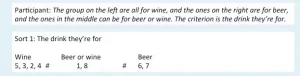
You continue repeating the process until:
•You run out of time.
•The participant can’t think of any more categories. If they want to keep going, and need a nudge, you can again choose two cards at random and ask for the main single difference between them, and then use this as the basis for another sort.
You can analyse the card sorts results in various ways, including:
•Content analysis on the criteria and groups that participants use, to identify important attributes.
•Co-occurrence matrices to find out which cards are perceived as being most similar to which others, for e.g. identifying nearest competitors.
Other methods that fit well with card sorts
Card sorts are useful for finding out which categories people consider important, but they don’t tell you why the participant considers a particular category important, or what they mean by a particular term. To get this broader context, you can use:
•Upward laddering on goals and values, to find out why the participant considers something important.
•Downward laddering on explanations, to find out what the participant means by a particular term.