Hyde & Rugg:
We solve hard problems
Hyde & Rugg:
We solve hard problems
Upward laddering is useful for systematically mapping out someone’s goals and values.
Strengths of this method:
At a glance: An upward laddering chain

Choose two items as your starting point.
The two items can be almost anything. Some common choices are:

Ask the participant which of the two they would prefer, and why.
Tip: If they start giving a long explanation, ask them to slow down, and make it clear that you’re going to write down their exact words.
Record their answer verbatim, i.e. using their exact words.
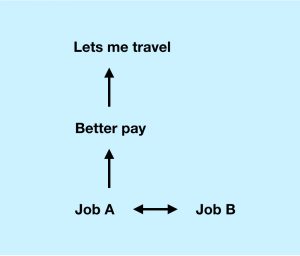
The picture below shows how this is recorded.
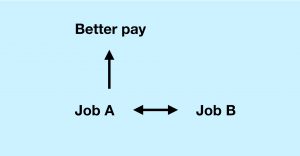
The two items used as a starting point are Job A and Job B.
The double-headed arrow between them is the laddering notation for ‘Which of these two would you prefer, and why: Job A, or Job B?’
The upward arrow above Job A is the laddering notation showing that Job A was preferred, because of Better pay.

Ladder up again from the participant’s preferred option, by asking Why would you prefer this? or by asking the participant why what they have just mentioned (e.g. Better pay) is important to them.
Tip: Never assume that the answer is obvious; a key strength of this method is that it finds unexpected results.

Step 5: Record their answer verbatim, using their exact words.
The picture below shows how this is recorded and added to the chain.
Repeat the process.
You continue repeating the process until:
When you reach the top of a particular chain, you can start again with another two items as your starting point.
Tip: Always start each chain as a new fresh diagram; if you try to fit more than one chain into a diagram, it quickly becomes unmanageable.

You can analyse the results in various ways, including content analysis on the goals and values that different people use.